How Hua Hin's New Infrastructure Is Reshaping the Property Market

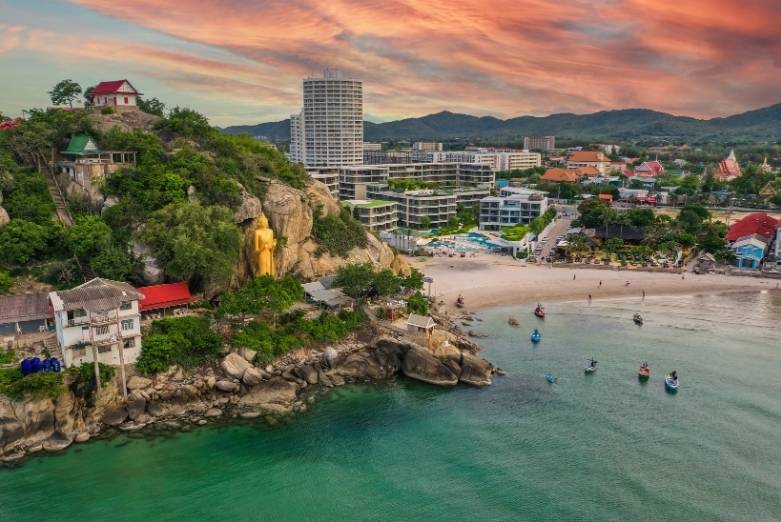
For years, Hua Hin has been described as Thailand's quieter alternative to Phuket or Pattaya, a royal seaside town favored by weekenders from Bangkok and a small but steady stream of retirees. That description is starting to look outdated. Over the past eighteen months, a cluster of transport projects, an international-grade airport upgrade, a widened coastal highway, an elevated motorway easing the notorious Rama II Road bottleneck, and a modern double-track rail line have all been advancing at the same time. Individually, each of these projects would matter to anyone weighing a move to the district. Together, they mark a shift in how easily Hua Hin can be reached from Bangkok, from the rest of Thailand, and eventually from abroad.
An Airport Built for International Arrivals
Hua Hin Airport has served domestic routes only for most of its history, with Thai AirAsia operating a handful of weekly flights to Chiang Mai. In 2024, the airport still logged more than 75,000 passengers despite that limited schedule, a sign of underlying demand that the existing infrastructure simply could not capture. That is changing quickly. The runway has been widened to 45 metres to accommodate larger aircraft, and the upgraded strip is now going through inspection by the Civil Aviation Authority of Thailand ahead of full certification. A second phase of works, covering the road tunnel, runway strip, and runway-end safety areas, is targeted for completion by August 2026.
The push has real political weight behind it. In late May 2026, the Prime Minister's office confirmed plans to fast-track Hua Hin's transformation into an international gateway as part of a wider strategy to channel tourism income into secondary provinces. By early July, tourism and hospitality operators from Hua Hin and Cha-am had already met with Thai AirAsia to discuss specific international routes, with destinations across Southeast Asia under review. None of this guarantees a fixed date for the first international flight, but the direction of travel is clear: an airport that has spent decades as a local convenience is being built out for a very different role.
Faster Roads Between Bangkok and the Coast
Road remains the way the overwhelming majority of visitors reach Hua Hin, and it shows in where the government has been spending money. Highway 37, the road that loops around Hua Hin itself, is partway through a roughly seven-billion-baht widening project that adds lanes, interchanges, and U-turn points to ease the daily congestion around the town centre, with completion expected by late 2026.
The bigger structural fix sits further north. Rama II Road, the main route south out of Bangkok, has been a byword for delay for years, thanks to a rolling set of construction projects layered on top of ordinary traffic. The elevated M82 motorway built above it is being opened in stages: an early stretch opened for a free trial in October 2025, and the remaining section between Ekkachai and Ban Phaeo was due to open in April 2026, with the full 45-kilometre route not reaching complete operation until 2027 or 2028. Further down the line sits the proposed Nakhon Pathom-Cha-am motorway, a 109-kilometre four-lane route that would bypass much of the Rama II corridor entirely. It was one of eleven megaprojects the Ministry of Transport flagged for 2026, though it is still moving through study and Cabinet approval stages rather than construction. Given that more than 98 percent of visitors to Cha-am and Hua Hin currently arrive by car, progress on this corridor arguably matters more to the district's accessibility than any single rail or air project.
Rail That Is Already Running
Unlike some of the road and air projects still in planning, Hua Hin's rail upgrade is largely a done deal. The double-track line between Nakhon Pathom and Chumphon, which runs through Cha-am and Hua Hin, has been operating with double tracks and modern signalling on the stretch between Hua Hin and Prachuap Khiri Khan since 2023, and the wider project was reported at more than 72 percent complete overall, with full completion targeted for 2026. Hua Hin's own station was rebuilt as part of the works, a modern elevated platform standing alongside the preserved colonial-era station building that has long been one of the town's recognisable landmarks.
A separate, far larger project, a high-speed line between Bangkok and Hua Hin that would eventually cut the journey to around an hour, remains at a much earlier stage. It is still under feasibility review rather than under construction, so it belongs on a longer horizon than the projects already delivering results. What is already in service, the upgraded conventional line, is enough on its own to have shortened a journey that once regularly took five hours down to closer to two and a half.
What the Convergence Means for the Property Market
It is unusual for a district anywhere in Thailand to have meaningful progress on air, road, and rail access all landing within the same eighteen-month window. Individually, any one of these upgrades tends to nudge a local property market. An airport gaining international routes typically widens the pool of buyers and renters to include people who were previously put off by a long or awkward transfer. A shorter, more reliable road or rail journey does something similar for the Bangkok weekend-home and retirement crowd, who already make up a large share of demand in Hua Hin.
Seeing all three move at once is what makes the current period worth watching. Developers and agents marketing property in the district are increasingly pitching it to a wider audience than the traditional Bangkok second-home buyer: retirees relocating from further afield, and international buyers who previously ruled out a town without direct flight access. A look through the current listings of properties for sale in Hua Hin gives a sense of how varied that audience has become, spanning everything from beachfront condominiums to hillside pool villas.
None of this should be read as a guarantee of an overnight price jump. Thailand's infrastructure timelines have a well-documented habit of slipping; the double-track rail line itself took years longer than its original schedule, and the Nakhon Pathom-Cha-am motorway has not yet broken ground. A more realistic reading is that Hua Hin's accessibility will keep improving in stages through 2026, 2027, and beyond, rather than all at once. For anyone with a multi-year view of the district, though, that steady direction of travel, rather than any single completion date, is the more important signal.
A Market Still Ahead of Its Infrastructure
Property markets in destinations like this one rarely move in step with construction schedules. Prices tend to adjust once a project is finished and its effects are visible in traffic counts, flight schedules, and tourist arrivals, which means the window between under construction and fully open is often where the most attractively priced opportunities sit. Hua Hin, with an airport nearing international certification, a rail line already delivering a shorter Bangkok journey, and several road projects at various stages of completion, currently sits somewhere in the middle of that window.
That does not remove the usual due diligence that comes with any purchase; checking title, zoning, and the reputation of a developer still matters as much as it ever did. But it does mean the conversation around Hua Hin has shifted from whether the town can support serious long-term investment to how quickly its transport links will let it capture the demand that better access typically brings.
โพสตอบ
* ต้องล็อกอินก่อนครับ ถึงสามารถเโพสตอบได้